
Junctions
The M50's junctions, one by one
The junctions of the M50 are numbered, and the number is the most important part of the information. What follows is a description of the kinds of junction you will meet, rather than a map of the individual points.
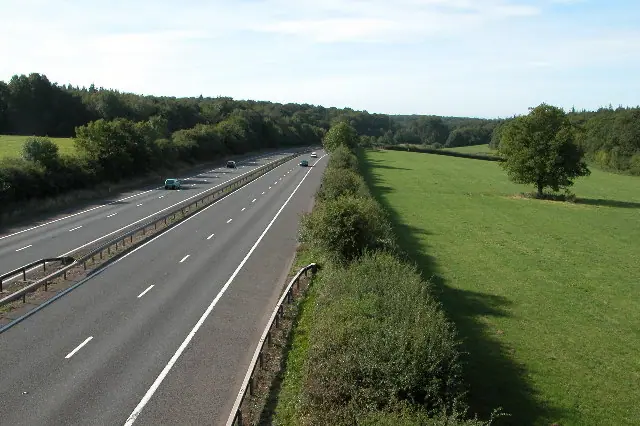
The M50. Photograph: Philip Halling (CC BY-SA 2.0), via Wikimedia Commons.
What a junction is
A junction is a place where roads meet or divide. On a motorway, junctions are designed so that every onward movement is free of a direct crossing.
The result is that bridges, ramps and lighting are needed. That is why the M50 is as large as it is in places.
The port boundary junction
A junction that links the motorway to a port area. Goods traffic is usually heavier here.
A junction where another motorway connects
A two-level junction that divides traffic between two motorways. These are the ones where choosing a lane early matters most.
A junction with a national road
A link to an N road heading out of the city. Overhead signs and distance signs appear here.
An urban junction
A junction set beside a residential or commercial area. It can be more compact than a junction in open country.
A junction with a regional road
A link to an R road. The approaches are shorter, and there is more turning.
A tolled junction
A junction where the toll is collected electronically. You usually need not stop.
A junction with a long ramp
A junction with a long ramp, which lets vehicles gain speed or shed it.
A junction with a cross route
A junction where another route passes above or below the ring road.
The final junction of the ring
The point where the motorway ends and traffic joins another route.
The list is not exhaustive, and no navigational guidance is given on this page. Consult signs and official maps.
A junction's number is more useful than its name. Names can change; the number cannot.
How to use a junction
This is not driving advice. It is a description of the decisions that have to be made as you approach a junction.
-
01
Find the number
You will see it on signs before the junction. Find it early.
-
02
Choose your lane
If you are continuing on, keep to the lane furthest from the exit.
-
03
Follow the sign
Make your decision on the evidence of the sign you passed before the junction, not at the junction itself.
Why junctions are so different
Not every junction is built in the same way. Four things settle the kind of junction that gets built: the volume of traffic expected, the space available, the type of road it connects, and the speed on the motorway itself.
In the city there is often little room. The result is junctions that are more compact and more complex, with short ramps and lighting. In the countryside there is more space, and longer ramps can be used.
The difference is plain to see if you compare some of the urban junctions on the M50 with a rural junction set in open country. The approach is not the same, even where the function is.
A cause of congestion
Congestion is often heaviest at the most complex junctions, because of the number of movements they carry. That is why traffic gathers before some junctions.
Details that change
Junction numbers or names may be altered over a long period. If we hold material that has gone out of date, please tell us.
Editorial
Content is written and reviewed in accordance with our editorial policy.
Corrections
If you spot an error, tell us at [email protected].
Contact
m50nline, 73 Clontarf Rd, Clontarf East, Dublin 3, D03 EP93, Ireland
+353 1 833 6364